Thursday, August 11, 2016

Book Review for "Ready Player One" (by Ernest Cline)

TITLE OF THE BOOK: Ready Player One 

AUTHOR: Ernest Cline

PUBLISHER: Broadway Books

NUMBER OF PAGES: 400

YEAR PUBLISHED: 2012

READING LEVEL: appropriate for teens and adults

GENRE: Science Fiction / Dystopian / Thriller & Suspense

BOOK SUMMARY: (From GoodreadsIn the year 2044, reality is an ugly place. The only time teenage Wade Watts really feels alive is when he's jacked into the virtual utopia known as the  OASIS. Wade's devoted his life to studying the puzzles hidden within this world's digital confines, puzzles that are based on their creator's obsession with the po
p culture of decades past and that promise massive power and fortune to whoever can unlock them. When Wade stumbles upon the first clue, he finds himself beset by players willing to kill to take this ultimate prize. The race is on, and if Wade's going to survive, he'll have to win—and confront the real world he's always been so desperate to escape. 

OUR STAR RATING: 
4.4 stars


OUR GROUP REVIEW:

Almost everyone in our group loved reading Ready Player One, and especially loved remembering and reconnecting with so many cultural references from our childhoods. Almost all of us were born in the 80s or were kids in the 80s, so the huge variety of references to 80s music, games, movies, and trends was so fun for us to relive. Even those on the younger end of the group who can't remember much (or anything!) from the 80s still found it easy to connect with, and could find something to relate to, even if they didn't understand every single reference.

One of our members mentioned that part of what made this book such a successful read was the blending of past and future. It managed to capture everyone's interest, whether people typically read more historical fiction set in the past, or speculative fiction set in the future. Whatever someone's reading interests are, they are covered at some point in Ready Player One.


In one interesting passage in the book, Wade says that he has been lied to. Everything he's been taught to believe in -- from religion, to cultural myths like Santa and the Easter Bunny -- is a fairy tale, and he wishes that he had been told the truth. This led to a really interesting group discussion about the 'lies' we tell our children. How do we pass on our religious beliefs to our kids? How do we talk to our kids about Santa, or other traditions? How do they feel when they discover that something we have taught them about might not actually be true, and how do parents handle their feelings if children feel they  have been lied to? One group member pointed out during our discussion that life is hard enough as it is, and it's a lovely thing to have a fairy tale to believe in.

In the book, real life is so bleak that almost everything chooses to spend all their time in the massive virtual universe called the OASIS. We spent a lot of time discussing the OASIS and the ways we already feel we are 'living' in it. In a way, we are already living in a sort of OASIS through our connection to social media. In the book, characters create avatars and can choose how they look and sound to others online -- much like we use Instagram and Facebook to present a beautiful, happy, mess-free version of our lives to others. Even through games like Pokemon Go and the SIMS, we can escape into a virtual world. Even our group love of books is a way of escaping from the real world!

We agreed that we also felt like we entered the OASIS with Wade as we read the book, and could feel a distinct change as the storyline moved from the real world into the OASIS. One of our group complaints about the book was that we wished there had been a bit more action and threat for Wade in the real world. There are brief moments of real life danger and suspense for Wade, but we wished we had seen a bit more of his life outside the game, and perhaps more tension in the real world to parallel what he experienced in the OASIS.


We also talked about the experience of meeting people in real life who we've only interacted with online, an experience that is getting more and more common with the rise of online dating and friendships made through blogging and social media. We had a wide range of experiences in the group, from members who felt disappointed that someone was completely different from what they had pictured in online chats, to members who met and made great real life friendships with online friends, or even fell in love and married someone they met online.

As a group, we almost always love the romance portions of the books we read and discuss. There wasn't much romance in this book, but we felt happy with the amount we got in this book, as it felt fitting for the plot.

We ended our discussion by asking if we would be interested in the OASIS, if it existed today. We unanimously agreed that the school and education opportunities presented in the OASIS sounded incredible, and we would love to experience that. But in our day-to-day life, most of us didn't think we'd spend much time there. However, if we lived in the book and the reality that existed there, then yes, we would definitely prefer to spend our time in the OASIS rather than the bleak world of the book.

Monday, April 18, 2016

Book Review for "Illuminae" {by Amie Kaufman and Jay Kristoff}

Book Title: Illuminae
Authors: Amie Kaufman and Jay Kristoff
Number of Pages: 599
Publisher: Knopf Books for Young Readers
Publication Year: 2015
Genre: Science Fiction

Summary: 

This morning, Kady thought breaking up with Ezra was the hardest thing she'd have to do.

This afternoon, her planet was invaded.

The year is 2575, and two rival megacorporations are at war over a planet that's little more than an ice-covered speck at the edge of the universe. Too bad nobody thought to warn the people living on it. With enemy fire raining down on them, Kady and Ezra--who are barely even talking to each other--are forced to fight their way onto an evacuating fleet, with an enemy warship in hot pursuit.

But their problems are just getting started. A deadly plague has broken out and is mutating, with terrifying results; the fleet's AI, which should be protecting them, may actually be their enemy; and nobody in charge will say what's really going on. As Kady hacks into a tangled web of data to find the truth, it's clear only one person can help her bring it all to light: the ex-boyfriend she swore she'd never speak to again.

Told through a fascinating dossier of hacked documents--including emails, schematics, military files, IMs, medical reports, interviews, and more--Illuminae is the first book in a heart-stopping, high-octane trilogy about lives interrupted, the price of truth, and the courage of everyday heroes.

Our star rating:


Friday, July 24, 2015

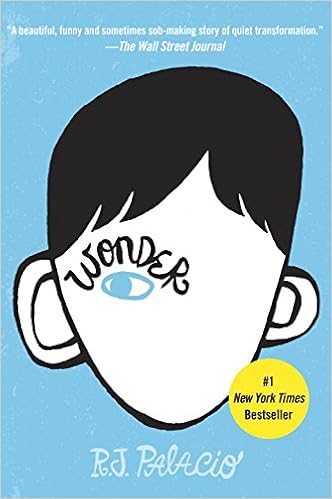
Book Review for Wonder (R.J. Palacio)

Wonder book review

TITLE OF THE BOOK: Wonder 

AUTHOR: R.J. Palacio

PUBLISHER: Knopf Books for Young Readers

NUMBER OF PAGES: 320

YEAR PUBLISHED: 2012

READING LEVEL: ages 8 and up

GENRE: middle grade

SUMMARY: August Pullman was born with a facial difference that, up until now, has prevented him from going to a mainstream school. Starting 5th grade at Beecher Prep, he wants nothing more than to be treated as an ordinary kid—but his new classmates can’t get past Auggie’s extraordinary face. WONDER, now a #1 New York Times bestseller and included on the Texas Bluebonnet Award master list, begins from Auggie’s point of view, but soon switches to include his classmates, his sister, her boyfriend, and others. These perspectives converge in a portrait of one community’s struggle with empathy, compassion, and acceptance. 

OUR STAR RATING:

Friday, February 14, 2014

"The Monuments Men" Book Review {by Robert M. Edsel}

TITLE OF THE BOOK: The Monuments Men: Allied Heroes, Nazi Thieves, and the Greatest Treasure Hunt in History
AUTHOR: Robert M. Edsel (Bret Witter, Contributor)
NUMBER OF PAGES: 496
YEAR PUBLISHED: 2009
PUBLISHER: Little Brown and Company
GENRE: Historical Non-fiction

SUMMARYAt the same time Adolf Hitler was attempting to take over the western world, his armies were methodically seeking and hoarding the finest art treasures in Europe. The Fuehrer had begun cataloging the art he planned to collect as well as the art he would destroy: "degenerate" works he despised.

Focusing on the eleven-month period between D-Day and V-E Day, this fascinating account follows six Monuments Men and their impossible mission to save the world's great art from the Nazis. In a race against time, behind enemy lines, often unarmed, a special force of American and British museum directors, curators, art historians, and others, called the Monuments Men, risked their lives scouring Europe to prevent the destruction of thousands of years of culture. 

OUR STAR RATING:

3.5 out of 5


OUR GROUP REVIEW: Overall, we felt like the book had amazing details and we were in awe at the extensive research that Robert Edsel did in preparation for the book. Just as mentioned at the beginning of the book, Edsel admitted to acquiring so much information on the Monuments Men and their efforts that he had to separate the discoveries and activities that took place in Italy for another book--Saving Italy, published in 2013.

Many of us had a hard time following the story because it did seem to jump around and there were so many characters to keep track of. I put together this PDF guide here for the main characters of the book (I wished I would have had something like this while I was reading). 


Brittanie created an awesome PowerPoint here. Her presentation gave us a snapshot of the main characters in the book and some key places that were a part of their story, including Altuassee and Monte Cassino.

We watched the trailer for "The Monuments Men" movie, which several Delicious Reads members went together to see that weekend. Though the movie isn't as historically accurate as the book (they even gave the main characters different names) and many of the events were over-dramatized, the overall feel for the book gives a little taste of what went on with the Monuments Men.

We also watched a clip here from an old black and white movie, called "The Train." The movie is based on a book the Rose Valland wrote called Le front de l'art. The scene we watched is supposed to be representative of Rose Valland and her role as a spy that helped the MFAA. 


Some of the other key points we discussed were: 
(see here for a full list of discussion questions we used)

1.) It was ironic that Hitler despised the Jewish, but coveted their art and belongings. He wanted all of the art that was German or what he considered German. He took everything. Harry Ettlinger said years after the war, "My knowledge of the Holocaust started really with the realization that it was not only the taking of lives...but the taking of all of their belongings." We liked that Harry got some of his grandfather's stuff back (though he still keeps it hidden away in a closet).

2.) The Monuments Men had the credentials and the passion for art to risk their lives for this cause. The story of the rescue of a sixteenth-century Flemish painting details how, in the midst of the fighting, two Monuments Men, Walter Hancock and George Stout, carefully wrote detailed notes on the painting. It definitely took a special kind of person with an interest in and/or passion for the arts to be a Monuments Man. The outcomes wouldn't have been the same if a soldier had been assigned to that division who did not have an interest in art.

3.) In a letter to a colleague on October 4, 1944, George Stout recounts his conversation with an old colonel about his activities in the MFAA division, and how the colonel became more and more interested and excited. Stout closes the letter by writing, "Perhaps [. . .] this simple, curious outlook of healthy men is more important than some of the monuments themselves."  
-We agreed that this was true to an extent, though some of the men would have sacrificed themselves for the art (and some did--Walter Huchthausen and Ronald Balfour). 
-We have an emotional connection to art, we seek for it.
-The beauty/ray of light in the war that these men saw was: "I can save this!" They were doing something that wasn't destructive--saving not destroying like the rest of the war caused.

4.) We loved Rose Valland! Of course she was the only woman mentioned so it was easy to stand out, but we loved her attitude too.  She was strategic and had allies on both sides. Rose Valland believed “My duty is to the art.” We thought that the author's constant talk about her being matronly and unattractive may have been excessive.  We believed her plainness was a choice too, that is made her not stand out so she could do what she did.

5.) On May 13, 1945, Monuments Man Lincoln Kirstein wrote about Altaussee, wondering, “How could one of the most important and unbelievable moments in art history—not to mention the history of a world war—simply become a forgotten footnote?” Despite his disbelief that this could ever happen, for the most part the role of the Monuments Men did remain largely forgotten or unknown until recently. We believed this was due to the fact that so much horror happened at the same time.

Brittanie showed us the size of the Ghent Altarpiece that the Monuments Men had to move. She mapped it out using large paper to give us an idea of the size (it covered the whole side of Kelly's living room and half the book club members!):

6.) We felt like this quote summed up some of our feelings over WWII and the cultural impact of Hitler: 

"But the lasting impact of his bitter reign is best measured in more ephemeral ways, fifty million loved ones who never returned home from the war to rejoin their families or start one of their own; brilliant, creative contributions never made to our world because scientists, artists, and inventors lots their lives too early or were never born; cultures built over generations reduced to ashes and rubble because one human being judged groups of other human beings less worthy than his own." (The Monuments Men, page 402)

Don't forget to check out our full photo recap of the night HERE!

*CONTENT CATEGORIES*
*RATING*
LANGUAGE/PROFANITY
MILD
SEXUALITY
MILD
VIOLENCE
MODERATE (bombs/explosions)
DRUG/ALCOHOL USE
MILD
INTENSE/SCARY SCENES
MODERATE (WWII & Hitler references)